The Elemental Architectures: Kinetic Engines vs. Absorptive Depth
This article may contain affiliate links. If you make a purchase through one of these links, we may earn a small commission at no extra cost to you.
In the analytical study of interpersonal synastry, the interaction between lunar elements serves as the primary indicator of emotional compatibility and long-term relational sustainability. At The Lunar Blueprint, we analyze the Moon not as a mystical symbol, but as the unconscious psychological infrastructure—the mechanism of instinctual reaction, self-soothing patterns, and the primary mode of emotional processing.
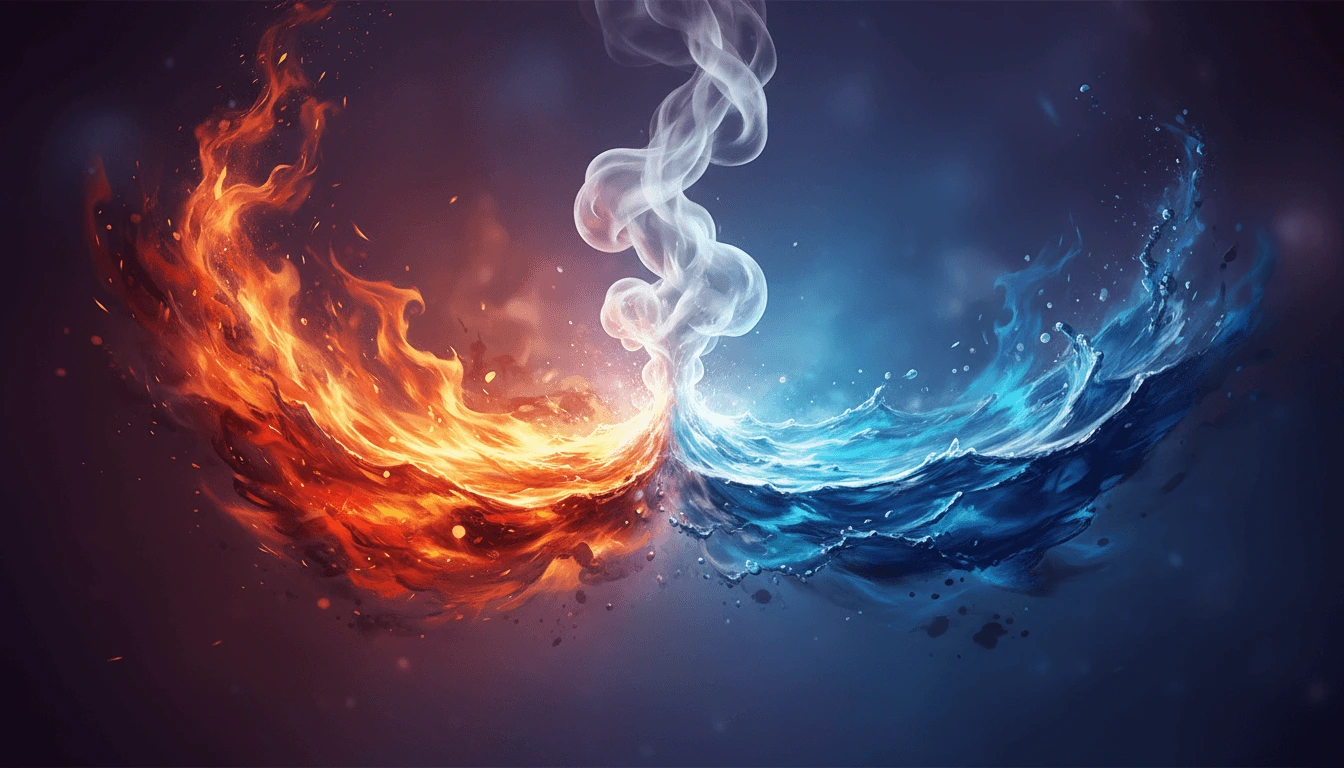
When the elemental signatures of two individuals’ Moon Signs fall into the categories of Fire and Water, a complex thermodynamic interchange occurs. This relationship, characterized by the paradoxical potential for both creative “steam” and mutually destructive “extinguishment,” necessitates an exploration of the fundamental discrepancies in emotional processing speed, communication styles, and the psychological “refractory periods” that govern how individuals recover from emotional stimuli.
To comprehend the dissonance between Fire and Water, we must first deconstruct their underlying emotional architectures. These elements operate on opposing energetic vectors: Fire is expansive and outward-pushing (centrifugal), while Water is intensive and inward-pulling (centripetal).
The Kinetic Engine of the Fire Moon
Fire Moons (Aries, Leo, Sagittarius) find emotional fulfillment through action, movement, and the assertion of personal autonomy. For these individuals, an emotion is essentially a fuel source; it is meant to be burned through, expressed, and transformed into kinetic energy as quickly as possible.
- Aries Moon: Operates through rapid externalization. Their emotional security is contingent upon remaining sovereign and free from annoyance. They process feelings with such speed that they often overwhelm partners, viewing any form of emotional hesitation as a waste of vital time.
- Leo Moon: Focuses on the maintenance of a consistent self-image. Their emotional well-being is tied to external validation. For a Leo Moon, the greatest emotional threat is invisibility; they require adoration to feel safe and process emotions through the lens of being “seen.”
- Sagittarius Moon: Motivated by a search for truth and philosophical expansion. Their emotional state is settled only when they feel a sense of freedom and a lack of stagnant routine.
The Absorptive Depth of the Water Moon
In contrast, Water Moons (Cancer, Scorpio, Pisces) navigate the world through intuition, sensitivity, and a high degree of emotional porosity. Their primary mode is not action, but feeling; they soak in the environment, often struggling to distinguish their own emotions from the collective atmosphere.
- Cancer Moon: Ruled by the Moon itself, these individuals are archetypal “absorbers.” Their processing is cyclical and defensive; they possess a soft interior protected by a hard shell and communicate through subtle emotional cues rather than direct verbalization.
- Scorpio Moon: Characterized by emotional stamina. Their feelings are intense, secretive, and incredibly enduring. They gauge reactions and unearth hidden secrets before revealing their own inner world.
- Pisces Moon: Function as “emotional sponges” that absorb every nuance of their surroundings. They often retreat into fantasy to avoid the harshness of the physical world, struggling with boundaries and emotional grounding.
Thermodynamic Conflict: The Physics of Extinguishment and Evaporation
The struggle to synchronize can be modeled through the physical interactions of fire and water. Research into fire dynamics shows that fire is a rapid exothermic reaction requiring fuel, heat, and an oxidizing agent. Water, having a high heat capacity, acts as a potent extinguishing agent by cooling the flame and physically splitting the fuel from the oxidizer.
In a psychological context, the “nurturing” and “containing” nature of a Water Moon often inadvertently acts as a suppressant on the Fire Moon’s burning need for autonomy. A Water Moon’s demand for emotional security and solitude can be perceived by a Fire Moon as a form of “smothering.” If the Water Moon attempts to contain the Fire Moon’s energy to ensure their own safety, they effectively “inert” the Fire Moon’s vitality, leading to feelings of being stuck.
Conversely, the intense heat generated by a Fire Moon can cause the Water Moon to “evaporate.” For a sensitive Water Moon, the “vibration” of a Fire Moon’s temper tantrums and “brutal honesty” can be physically and emotionally painful. When exposed to the high “thermal expansion” of a Fire Moon’s emotional outbursts, a Water Moon may respond by escaping into fantasy or becoming defensively silent. The Fire Moon’s straightforward communication style can “scald” the Water Moon, causing their emotional boundaries to dissolve.
Kinetic Dissonance: The Emotional Refractory Period
A central reason for the lack of synchronization is the discrepancy in the “emotional refractory period”—the duration of time after a stimulus during which an individual is unable to return to baseline.
Psychological studies on anger and sadness modulation suggest that different emotional states carry different “decanting” times. Fire Moons possess a remarkably short refractory period. Because they act on what they feel and express emotions freely, they discharge energy immediately. An Aries Moon’s temper tantrum may blow over in minutes; they get over things quickly and are ready for the next adventure while their partner is still reeling.
Water Moons, however, have a high “mechanical resistance” to emotional change. When a Water Moon is hurt, they absorb the emotion into their very structure. Scorpio Moons, in particular, possess the emotional stamina to “stew” or ruminate on an issue for days or even weeks.
This creates a kinetic gap: the Fire Moon attempts to “clear the air” through direct confrontation, but this very act often resets the Water Moon’s refractory period, keeping them in a state of high anxiety. The Fire Moon becomes frustrated by the “stagnation,” while the Water Moon is traumatized by the “harshness.”
Understanding your synastry is just the surface. To see the full map of your emotional blueprint, check out this personalized video analysis.
The Failure of Containment: Bion’s Beta Elements
In psychodynamic theory, Wilfred Bion described “containment” as a process where one partner acts as the container to process another’s raw, unprocessed feelings (beta elements). For a relationship to synchronize, both partners must be able to transform these raw feelings into “thinkable” thoughts (alpha elements).
In Fire-Water Synastry Aspects, this process often fails. Fire Moons project “beta elements” with high velocity. They expect the Water Moon to catch and “cool” these feelings. However, because Water Moons are so porous, they often don’t just contain the energy—they are overwhelmed by it. Instead of detoxifying the Fire Moon’s rage or excitement, the Water Moon becomes “flooded.”
This leads to “parasitic containment,” where one partner’s emotional labor drains the other without providing reciprocal support. The Fire Moon feels unheard because the Water Moon has withdrawn into their shell, while the Water Moon feels exploited by the constant demand to “process” the Fire Moon’s intense energy.
Alchemical Synthesis: The Generation of Steam
Despite these inimical qualities, Stephen Arroyo suggests that the Fire-Water relationship is potentially the most exciting, creating a “sizzling” dynamic when managed correctly. The goal of this pairing is not “harmony” in the traditional sense, but the creation of “steam.”
Steam is water at a high vibration of movement. This implies that a Fire-Water pairing can elevate the emotional experience of both partners, provided they do not “extinguish” each other in the process. This requires a mutual understanding that:
- Speed is not Insensitivity: The Fire Moon’s need for concise and direct answers is a sign of their self-reliance, not a lack of caring.
- Depth is not Stagnation: The Water Moon’s need to ruminate is a necessary part of their mechanical resistance to emotional trauma, not an attempt to “smother” the Fire Moon.
Strategies for Thermal Regulation
To achieve alchemical synchronization, we recommend the following “thermal regulation” strategies:
- Acknowledge the Refractory Gap: Fire Moons must learn to grant “decanting time.” Demanding an immediate resolution from a Water Moon during a conflict is like adding heat to a boiling pot—it only creates more pressure.
- Imaginative Play and Alchemical Tools: Using play or creative expression can help transform “big feelings” for both signs. For the Water Moon, it provides a safe outlet for depth; for the Fire Moon, it provides the “newness” they crave.
- Environmental Anchors: Since Fire Moons need movement and Water Moons need serenity, shared exposure to nature—where wind (Fire’s ally) and bodies of water coexist—can act as a natural stabilizer.
- Practice Alpha-Transformation: Water Moons must work on expressing their needs more assertively (turning feelings into “thinkable” thoughts), while Fire Moons must practice tact to avoid “scalding” their sensitive partners.
Synchronization occurs when the Fire Moon learns to respect the depth of the “pool” and the Water Moon learns to value the brilliance of the “flame.” This balance moves the relationship from a state of mutual destruction to one of alchemical steam, providing both the passion and the emotional security required for a conscious, data-driven bond.
Unveil Your Cosmic Architecture
Your natal chart holds the exact coordinates to your relationship patterns. Understand the deeper currents pulling you together.
Claim Your Free Moon Reading